
News
A New Home for Fireballs

What happened
In early September 2026, the server hosting amsmeteors.org, imo.net and our fireball reporting tools was hit by a cyber attack. The sites ran on a WordPress platform first built in 2010, and its problems could no longer be fully fixed by patches. Rather than restore the same vulnerable setup, we took the sites offline and rebuilt them properly.
The most important thing was quickly restored. Within a couple of days, the fireball report form was back online in a separate, protected environment. Eyewitness reports have kept flowing the entire time, and no fireball data was lost after the initial disruption.
What started as a recovery became a rebuild. Features that sat on our wish list for years are now live.
What's new
The centerpiece is the new Fireball Event Viewer: a fast, interactive map of fireball activity, day by day, anywhere in the world. It works on phones and desktops alike.
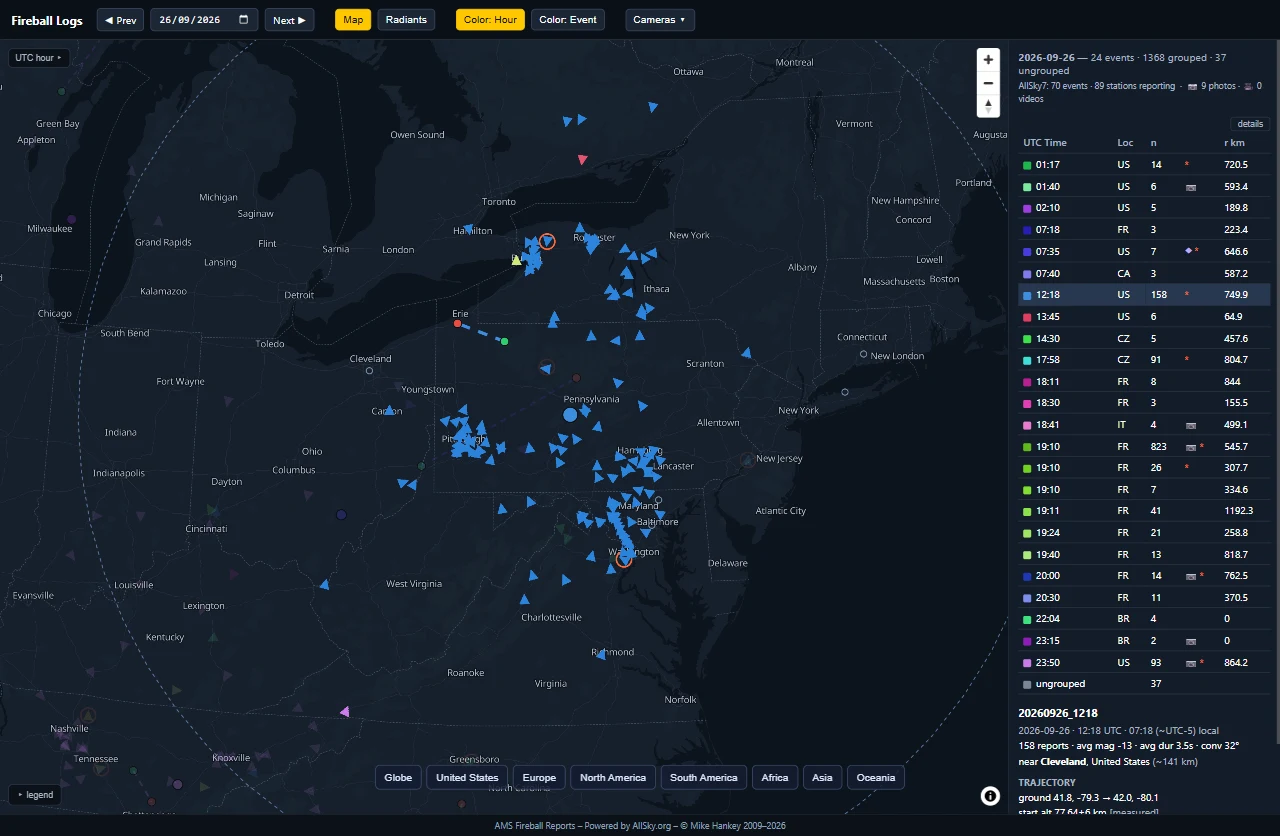
September 26, 2026 in the viewer: every report of the night, and the 12:18 UTC fireball near Cleveland, seen by 158 witnesses.
For any night you can:
- See every eyewitness report on the map, with the direction each witness saw the fireball travel.
- View the estimated ground path of each fireball, computed from the witness reports.
- Click any event for a summary: time, location, witness count, brightness and duration.
- Open witness photos and videos directly on the event, full size.
- Follow meteorite falls from the fireball that produced them to the recovered rocks, using the official meteorite record.
Beyond fireballs, the site is gaining a large body of new scientific content. Meteor radiants and orbits are being added, showing where meteors come from and the paths they followed through the solar system. More of this data will arrive in the coming months.
Camera network data
The AMS fireball reports now sit side by side with data from the AMS cameras. When the AllSky7 camera network records a fireball that people also reported, the viewer uses that data to confirm the event and add detail that eyewitness reports alone can't provide. The cameras also capture thousands of meteors every night, which is where the new radiant and orbit data comes from.
AllSky7 was invented and developed by Mike Hankey over a period of seventeen years, built from the start to serve the AMS fireball program and bolide tracking. Hankey's AllSky7 vision was published in Planetary and Space Science (2020) following the Meteoroids 2019 conference, in a paper co-authored by Dr. David Meisel, AMS Executive Director from 1973 to 2023. It was the last paper David published before his death in August 2025. The AllSky7 network of cameras operates in collaboration with the AMS and regional observing groups who contribute data to the AMS and IMO fireball programs.
We are getting many questions about how to get the AllSky7 camera hardware and join the AllSky7 Network and we'll be making a future announcement about how you can participate.
Reporting a fireball
The report form works exactly as it always has. It's the anchor of everything we do, so we kept it steady through the recovery. A redesigned form is coming in a future release. Report a Fireball
Links that keep working
News outlets and researchers often link to specific fireball events for years. Links from the old site still work and open the matching event in the new viewer. New events get clean links you can copy straight from your browser.
Faster, safer and far cheaper to run
We serve more than 2.5 million visitors a year, and a bright fireball can send tens of thousands to the site within minutes. The old platform cost thousands of dollars a month at peak, much of it for commercial map services billed per view.
The new site is built from pre-generated pages delivered through a global network of servers, with our own self-hosted maps. Pages load faster, hold up under traffic spikes, and offer far less for attackers to target. Over fifteen years of articles, guides and meteor shower information were carried over intact.
What's next
This first release covers the AMS site and the shared fireball tools. The IMO site is next and will follow shortly. Coming soon:
- Plain-language event summaries
- More ways to filter events, by media, camera coverage or witness count
- Local times for each event's location
- A "Did you see it too?" shortcut into a pre-filled report
- The redesigned report form
Thank you
To everyone who has reported a fireball, sent a photo, run a camera or recovered a meteorite: this is your data and your community. The AMS has documented fireballs since 1911, and this rebuild carries that mission forward.
Special thanks to co-developer Vincent Perlerin, and to the AMS and IMO board members for their support through a difficult time.
Go watch the sky, and when you see something, report it.
— The American Meteor Society