American Meteor Society
Yesterday I spent the day working with Claude AI (Opus 4.5) to dig into the AMS fireball database going back to 2011. The goal was to answer the question everyone’s been asking: is fireball activity actually up, or does it just feel that way?
The short answer: yes, it’s up — and the data tells us something interesting about why.
The number of large fireball events (those seen by 50+ witnesses) has roughly doubled in Q1 2026 compared to the five-year average. But the total number of fireballs is about normal. So it’s not that more rocks are hitting us — it’s that more of them are big enough to notice.
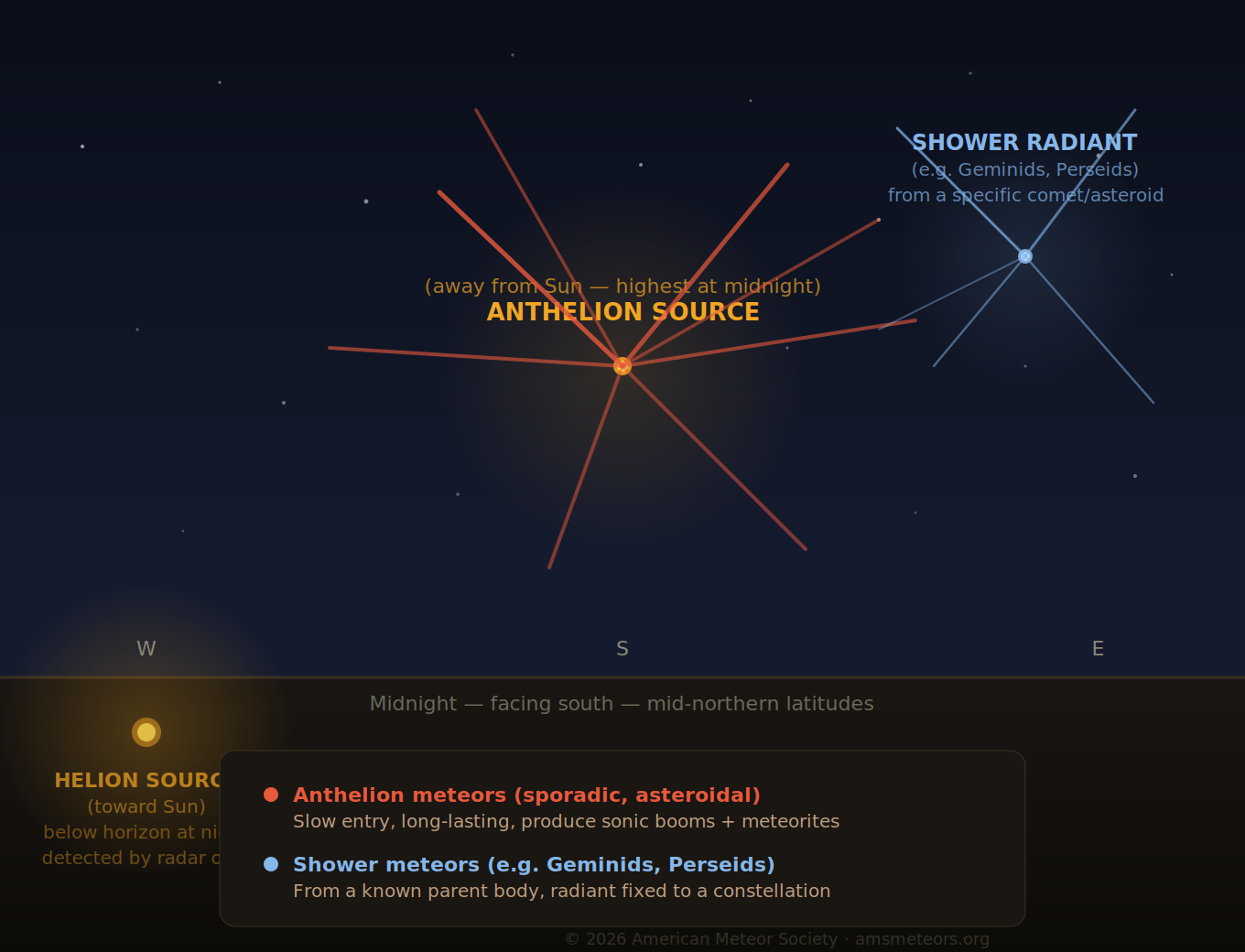
Anthelion, Helion and Meteor Shower Radiant Sources
Our radiant analysis shows the increase is concentrated around the Anthelion source — the region of sky directly opposite the Sun. These are asteroidal objects on orbits similar to Earth’s, moving in the same direction we are. When they encounter Earth, our orbital velocity is effectively subtracted from theirs, so they enter the atmosphere at relatively low speeds. Slower entry means the meteor lasts longer in the sky, is visible over a wider area, produces sonic booms more often, and more material survives to reach the ground as meteorites. That’s exactly what we’ve been seeing — including two rare HED achondrite falls (Germany and Ohio) in just nine days.
We’ve published a full data-driven analysis with interactive charts, computed radiants for 255 events, and a downloadable dataset for anyone who wants to check our work:
👉 2026 Q1 Fireball Analysis
As always — if you see a fireball, report it at https://fireball.amsmeteors.org. Every report matters.
Mike Hankey – AMS Operations Manager