 American Meteor Society

February offers the meteor observer in the Northern Hemisphere a couple of weak showers plus falling sporadic rates. This may not seem too exciting, but you never know when surprises are in store. An errant earthgrazer from the Centaurid complex may shoot northward. Better yet, a bright fireball may light up the sky. February is the start of the evening fireball season, when an abundance of fireballs seems to occur, as seen from the Northern Hemisphere. This lasts well into April. Sporadic rates are near maximum for those viewing from the Southern Hemisphere. There are no strong showers this month, but sporadic rates are in excess of 10 per hour as seen from mid-southern latitudes.
During this period, the moon’s phase will reach its full phase on Monday February 2nd. At that time, the moon will lie opposite the sun and will lie above the horizon all night long. As the week progresses the waning gibbous moon will rise later with each passing night, allowing a small window of opportunity to view under dark skies between dusk and moon rise.
The estimated total hourly rates for evening observers this weekend should be near 1 as seen from mid-northern latitudes (45°N) and 2 as seen from tropical southern locations (25°S). For morning observers, the estimated total hourly rates should be near 3 as seen from mid-northern latitudes (45°N) and 5 as seen from tropical southern locations (25°S). Rates are reduced by moonlight.
The actual rates observed will also depend on factors such as personal light and motion perception, local weather conditions, alertness, and experience in watching meteor activity. Note that the hourly rates listed below are estimates based on observations from dark-sky sites away from urban light sources. Observers viewing from urban areas will see less activity, as only the brighter meteors will be visible from such locations.
The radiant (the area of the sky from which meteors appear to originate) positions and rates listed below are exact for Saturday night/Sunday morning, January 3/4. These positions do not change greatly from day to day, so the listed coordinates may be used throughout this entire period. Most star atlases (available online, in bookstores, and at planetariums) include maps with celestial coordinate grids that can help you locate these positions in the sky.
I have also included charts of the sky that display the radiant positions for evening, midnight, and morning. The center of each chart represents the sky directly overhead at the corresponding hour. These charts are oriented for facing south but can be used for any direction by rotating them accordingly. A planisphere or planetarium app is also useful for showing the sky at any time of night on any date of the year.
Activity from each radiant is best seen when it is positioned highest in the sky (culmination), either due north or south along the meridian, depending on your latitude. Radiants that rise after midnight will not reach their highest point in the sky until daylight; therefore, it is best to view them during the last few hours of the night.
It must be remembered that meteor activity is rarely seen directly at the radiant position. Rather, meteors shoot outward from the radiant, so it is best to center your field of view so that the radiant lies near the edge rather than the center. Viewing in this way allows you to trace the path of each meteor back to the radiant (if it belongs to a shower) or in another direction if it is sporadic. Meteor activity is not visible from radiants located far below the horizon.
The positions below are listed in west-to-east order by right ascension (celestial longitude). The positions listed first are located farther west and are therefore accessible earlier in the night, while those listed farther down the list rise later.
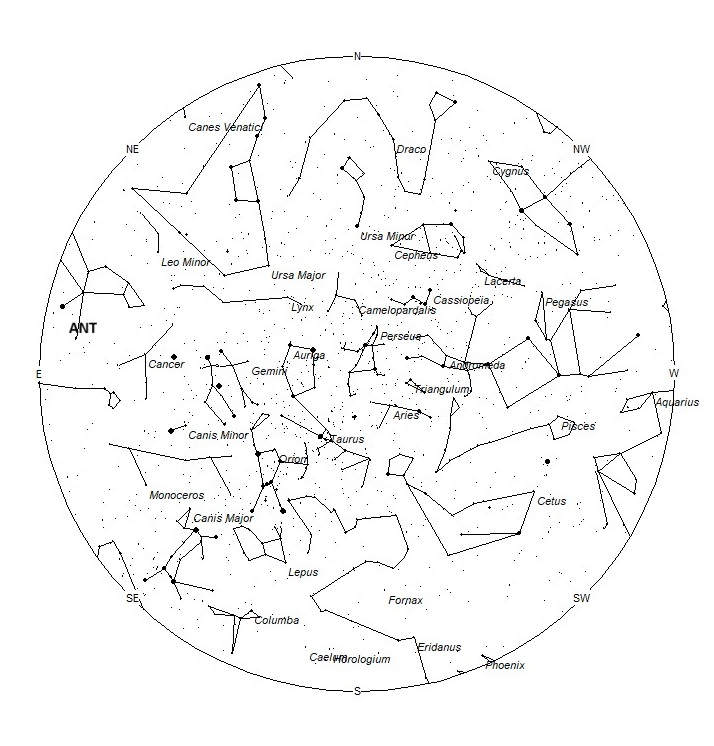
Radiant Positions at 19:00 Local Standard Time
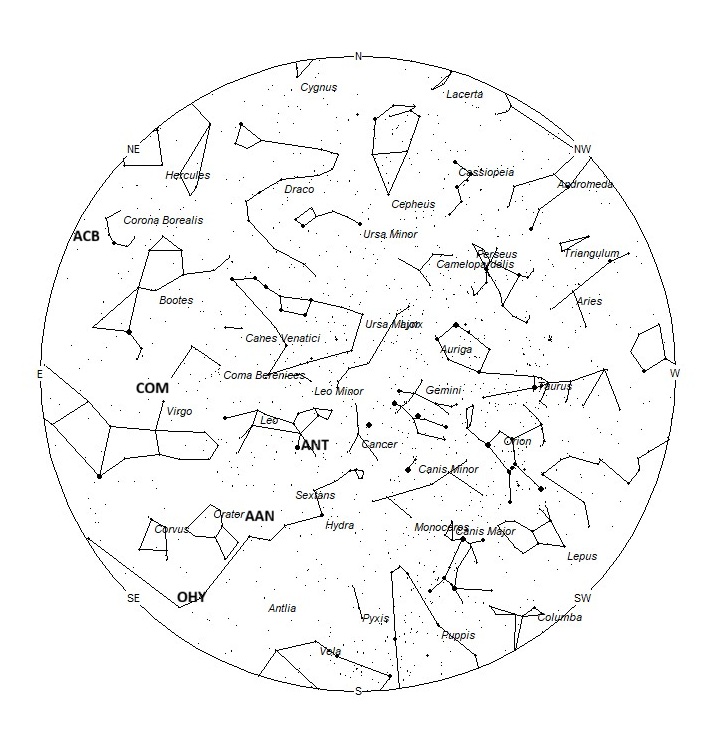
Radiant Positions at Midnight Local Standard Time

Radiant Positions at 05:00 Local Standard Time
These sources of meteoric activity are expected to be active this week
Details of each shower will continue next week when viewing conditions will be more favorable
The list below provides information in tabular form on the active showers that are within reach of the visual observer to discern. Hourly rates are often less than one, so these sources are rarely listed as visual targets in most meteor shower catalogs. If you, like me, wish to associate as many meteors as possible with known sources, you will appreciate these listings.
Before claiming to have observed meteors from these Class IV showers, you should determine whether they truly belong to them and are not chance alignments of sporadic meteors. Note parameters such as duration, length, radiant distance, and elevation of each meteor to help compute the probability of shower association.
It should be remembered that slow meteors can appear in fast showers, but fast meteors cannot be produced by slow showers. Slower showers are those with velocities less than 35 km/sec. Slow meteors can appear from fast showers when they occur close to the radiant or low in the sky.
The table located on page 23 of the IMO’s 2026 Meteor Shower Calendar is a helpful tool for identifying meteors. If you record the length and duration of each meteor, you can use this chart to check the probability of the meteor belonging to a shower of known velocity. If the angular velocity matches the figure in the table, your meteor probably belongs to that shower.
Recognizing meteors from obscure showers is not for beginning meteor observers—it takes many hours of practice to develop an instinct for what you’re seeing. It is our hope that you will move beyond simply watching meteors as a celestial fireworks display and help expand our knowledge of these heavenly visitors by classifying each meteor you observe.
Rates and positions in the table are exact for Saturday night/Sunday morning January 31 / February 1.
| SHOWER | DATE OF MAXIMUM ACTIVITY | CELESTIAL POSITION | ENTRY VELOCITY | CULMINATION | HOURLY RATE | CLASS |
| RA (RA in Deg.) DEC | Km/Sec | Local Standard Time | North-South | |||
| Anthelion (ANT) | – | 09:40 (145) +14 | 30 | 01:00 | 1 – <1 | II |
| alpha Antliids (AAN) | Feb 01 | 10:28 (157) -10 | 44 | 02:00 | <1 – <1 | IV |
| omicron Hydrids (OHY) | Feb 01 | 11:56 (179) -35 | 58 | 04:00 | <1 – <1 | IV |
| Comae Berenicids (COM) | Dec 19 | 13:16 (199) +12 | 63 | 05:00 | <1 – <1 | II |
| alpha Centaurids (ACE) | Feb 08 | 13:24 (201) -56 | 58 | 05:00 | <1 – <1 | II |
| alpha Coronae Borealids (ACB) | Jan 27 | 15:44 (236) +24 | 59 | 07:00 | <1 – <1 | IV |
| February eta Draconids (FED) | Feb 04 | 15:48 (237) +61 | 35 | 07:00 | <1 – <1 | IV |
You can keep track of the activity of these meteor showers as well as those beyond the limits of visual observing by visiting the NASA Meteor Shower Portal. You can move the sky globe to see different areas of the sky. Colored dots indicate shower meteors while white dots indicate sporadic (random) activity. The large orange disk indicates the position of the sun so little activity will be seen in that area of the sky.
Class Explanation: A scale to group meteor showers by their intensity:
- Class I: the strongest annual showers with Zenith Hourly Rates normally ten or better.
- Class II: reliable minor showers with ZHR’s normally two to ten.
- Class III: showers that do not provide annual activity. These showers are rarely active yet have the potential to produce a major display on occasion.
- Class IV: weak minor showers with ZHR’s rarely exceeding two. The study of these showers is best left to experienced observers who use plotting and angular velocity estimates to determine shower association. These weak showers are also good targets for video and photographic work. Observers with less experience are urged to limit their shower associations to showers with a rating of I to III.

I don’t know hat I saw at 9:37 ish tonight Jan 31,2026. It looked like a GIANT piece of paper burning with huge flames in the sky. It curved downward and then was gone!!