 American Meteor Society
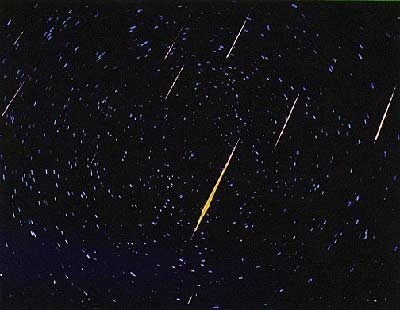
Leonid Meteor
Obtaining a meteor spectrum is not all that complicated. All you need is the equipment, and most of all, a lot of patience since you cannot predict where and when a bright meteor will occur. Just about any good camera from a 35 mm to a large format camera like a 4X5 press type can be used. You simply mount a prism or replica transmission diffraction grating in front of the lens, no slit is required. The dispersive element, prism or grating, breaks the light of the meteor up into a spectrum. Today, gratings are preferred over prisms as the dispersion is better and nearly linear. Good gratings are expensive, however. A 50X50 mm grating costs around $700- $800 US. A large format camera is preferred if you want to obtain good spectra. I made one of my own using a surplus aero lens (Kodak F-2.5 – 178 mm focal length lens using 4X5 film). You can sometimes find these lenses in used camera stores or on eBay.
Once you have the equipment, you then start taking time exposures of the night sky hoping a very bright meteor crosses your camera field of view. The flight path of the meteor must be parallel or nearly so to the grooves of the grating for good dispersion. If it is across the grooves no spectrum will be obtained. Generally speaking, only meteors brighter than magnitude -2.0 will produce a spectrum. With luck, one hopes for meteors much brighter than that. Unfortunately these are rather rare events. It takes on the average around 100 hours of exposure time to obtain one spectrum so you can go through a lot of film. Try and find a copy of the book, Amateur Telescope Making – Book Two, published by Scientific American in 1954. A good library should have a copy. There is an excellent chapter on Meteor Photography by the late Dr. Peter M. Millman, pioneer and world authority of meteor spectroscopy.
In order to get your feet wet, so to speak, you can use a thin film type, holographic grating for meteor spectroscopy. These are sold by Learning Technologies Inc . These acetate film type gratings concentrate most of the light into the first order spectrum. Higher orders are much weaker than a blazed precision replica grating and the efficiency is about 2 magnitudes lower. In other words you will need a -4 or so magnitude meteor to produce a spectrum. That means going through much more film before you are successful.
Getting a spectrum is only half of the task. It must be analyzed. This task requires special equipment like measuring engines and scanning microphotometers. Most of all, a lot of experiance analyzing spectra. This is best left to the professionals. This presents another problem. Professional meteor experts are very busy people, so only very good spectra will be selected for study. They have many spectra of their own that sit in archives because of lack of time to study them. Amateurs must be very patient when asking a professional to analyze your spectrum. I know this sounds difficult but one day you may be successful in securing the spectrum of a meteorite dropping fireball. One can always hope, anyway!